

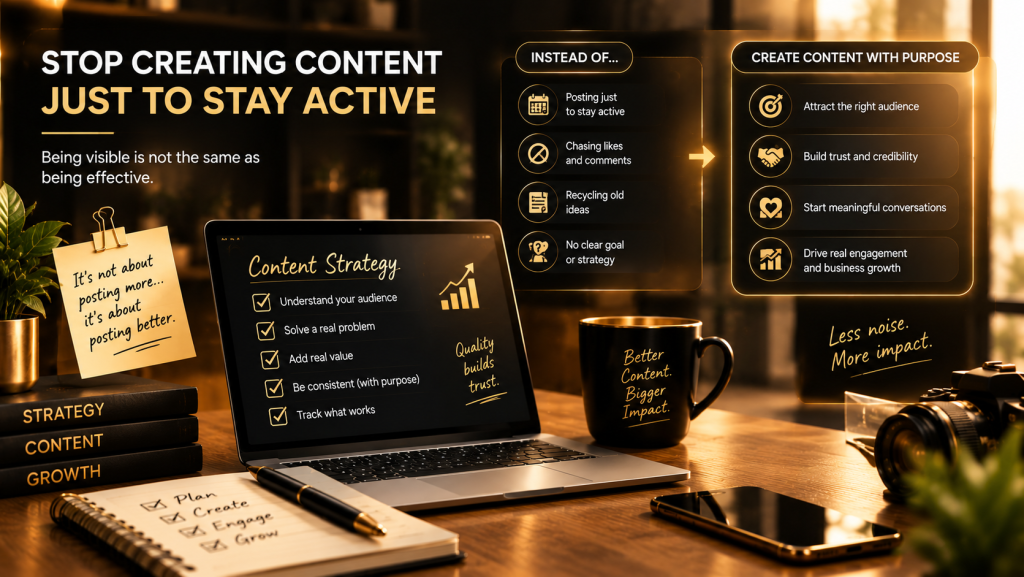
Stop Creating Content Just to Stay Active
Your Content Is Speaking for Your Brand — What Is It Saying? A THE NEXIVA Perspective on Content, Brand Perception & Trust Every time you publish something — a caption, a blog post, a product photo, an email, a website page — you’re not just sharing information. You’re speaking. And whether you realize it or not, your audience is listening closely, forming opinions about who you are, what you value, and whether you’re worth their trust. Most businesses think about content in terms of frequency: post more, rank higher, sell more. But content isn’t just a marketing task to check off a list — it’s a conversation. And like any conversation, the way you show up matters as much as what you actually say. If your content is inconsistent, generic, or careless, that’s exactly how your brand starts to feel in the eyes of your audience. If it’s thoughtful, valuable, and authentic, that’s what people begin to associate with you too. So here’s a question worth sitting with for a moment: what is your content actually saying about your brand right now? In short: Your content is a direct reflection of your brand. Every caption, page, email, and post either builds trust and recognition, or quietly chips away at it. Businesses that treat content as a strategic brand asset — not just a promotional tool — build stronger, more memorable, more trusted brands over time. What Does Your Content Communicate About Your Brand? Whether you intend it to or not, every piece of content you publish sends a message. It’s rarely just about the product feature you’re describing or the offer you’re promoting — it’s about the impression left behind. Content constantly signals things like: Your professionalism and attention to detail The values and priorities your business stands for The quality customers should expect from working with you Whether you genuinely understand your audience’s needs How trustworthy and credible your brand actually is Your personality and tone — serious, playful, premium, approachable None of this is accidental, even when it looks that way. A rushed caption, a stock photo that doesn’t match your brand, or a blog post stuffed with keywords instead of real answers — these all say something too, just not something you’d choose on purpose. Your Content Shapes First Impressions For most people today, the first “meeting” with your brand doesn’t happen in a store or on a sales call — it happens through content. A search result. A social media post. A homepage. An ad on their feed. Research on user behavior consistently shows that people form an opinion about a website or profile within seconds, long before they read a single sentence in detail. Layout, tone, imagery, and clarity all register almost instantly. Think about the difference between landing on a website with outdated design, cluttered text, and broken formatting — versus one that’s clean, purposeful, and easy to navigate. Or scrolling through an Instagram grid with mismatched fonts and inconsistent captions, compared to one that feels curated and intentional. In both cases, you form a judgment about credibility before you’ve evaluated a single product or service. That first impression is often the deciding factor in whether someone stays to learn more — or quietly moves on to a competitor. How Different Types of Content Speak for Your Brand Brand perception isn’t shaped by one type of content — it’s built across every touchpoint. Here’s what each major content format is really communicating. Website Content Your website is often the most detailed conversation you’ll ever have with a potential customer without speaking to them directly. Clear messaging, well-organized pages, and thoughtful copy say “we know what we’re doing.” Confusing navigation, outdated information, or vague service pages say the opposite — even if your actual work is excellent. Social Media Content Social platforms are where personality shows. Consistent visuals, a recognizable tone, and captions that add value build familiarity and trust over time. Random, disconnected posts with no clear voice make a brand forgettable, no matter how often it posts. Blog Content Blogs are one of the clearest signals of expertise. A blog that genuinely answers questions, explains concepts, and offers real insight builds authority. A blog that exists purely to insert keywords, with thin or repetitive content, signals the opposite — and search engines are increasingly good at telling the difference too. Email Marketing Email is a direct line to your audience’s inbox, which makes it personal. Relevant, well-timed, valuable emails build a relationship. Generic, overly frequent, purely promotional emails train people to stop opening — or to unsubscribe altogether. Visual Content Photos, graphics, and videos communicate before words even register. Consistent colors, quality imagery, and a recognizable style build visual trust. Low-effort or mismatched visuals — even paired with great copy — can undercut the credibility of everything around them. Advertising Content Ads are often a brand’s most public and repeated impression. Thoughtful, honest, well-targeted ads build recognition and trust over multiple exposures. Misleading claims, poor targeting, or overly aggressive sales language can create skepticism that outlasts the campaign itself. What Does Your Current Content Say About Your Brand? Before making changes, it helps to honestly audit where things stand today. Ask yourself: Would a stranger understand what we do within the first few seconds of visiting our website or profile? Does our content look and sound consistent across our website, social media, and emails? Are we providing real value, or mostly just promoting ourselves? Does our visual identity feel intentional, or randomly assembled? Would our content make someone trust us more, or feel unsure? If a competitor’s content and ours were placed side by side, which one would a customer choose? There are no perfect scores here. The goal is simply to see your content the way your audience does — because they’re already forming these judgments, whether you’re asking these questions or not. Common Content Mistakes That Can Damage Brand Perception Most brand-damaging content isn’t the result of a single bad
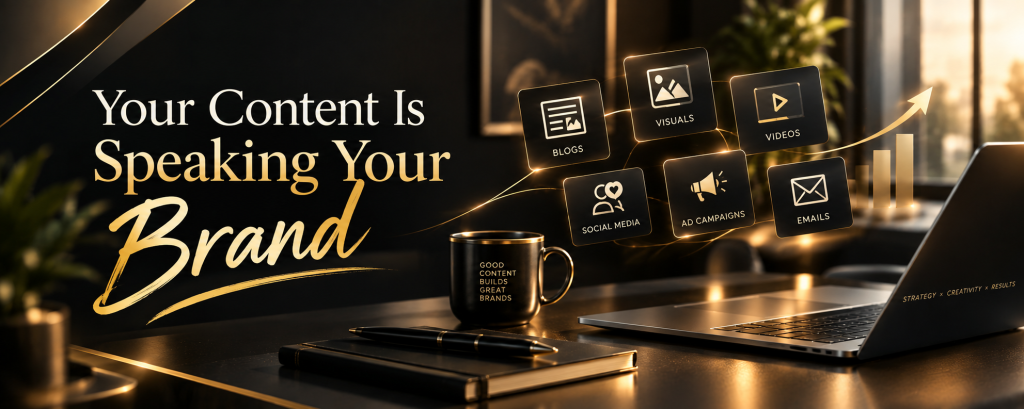
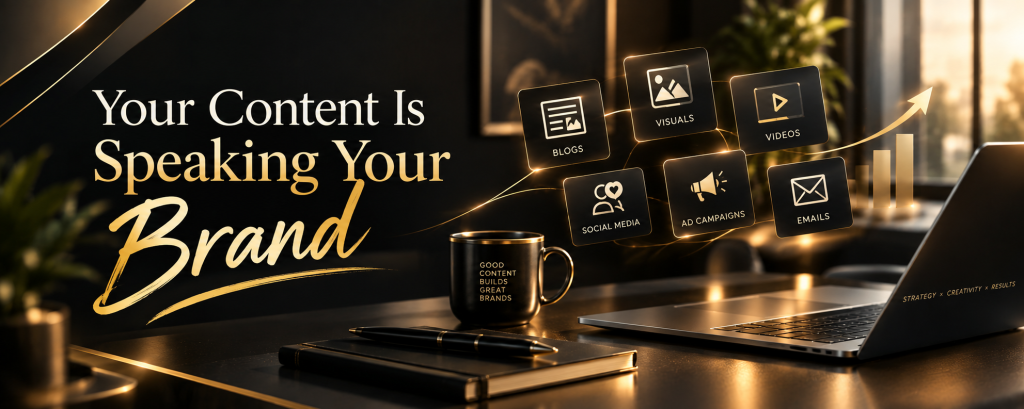
Your Content Is Speaking For Your Brand
Your Content Is Speaking for Your Brand — What Is It Saying? A THE NEXIVA Perspective on Content, Brand Perception & Trust Every time you publish something — a caption, a blog post, a product photo, an email, a website page — you’re not just sharing information. You’re speaking. And whether you realize it or not, your audience is listening closely, forming opinions about who you are, what you value, and whether you’re worth their trust. Most businesses think about content in terms of frequency: post more, rank higher, sell more. But content isn’t just a marketing task to check off a list — it’s a conversation. And like any conversation, the way you show up matters as much as what you actually say. If your content is inconsistent, generic, or careless, that’s exactly how your brand starts to feel in the eyes of your audience. If it’s thoughtful, valuable, and authentic, that’s what people begin to associate with you too. So here’s a question worth sitting with for a moment: what is your content actually saying about your brand right now? In short: Your content is a direct reflection of your brand. Every caption, page, email, and post either builds trust and recognition, or quietly chips away at it. Businesses that treat content as a strategic brand asset — not just a promotional tool — build stronger, more memorable, more trusted brands over time. What Does Your Content Communicate About Your Brand? Whether you intend it to or not, every piece of content you publish sends a message. It’s rarely just about the product feature you’re describing or the offer you’re promoting — it’s about the impression left behind. Content constantly signals things like: Your professionalism and attention to detail The values and priorities your business stands for The quality customers should expect from working with you Whether you genuinely understand your audience’s needs How trustworthy and credible your brand actually is Your personality and tone — serious, playful, premium, approachable None of this is accidental, even when it looks that way. A rushed caption, a stock photo that doesn’t match your brand, or a blog post stuffed with keywords instead of real answers — these all say something too, just not something you’d choose on purpose. Your Content Shapes First Impressions For most people today, the first “meeting” with your brand doesn’t happen in a store or on a sales call — it happens through content. A search result. A social media post. A homepage. An ad on their feed. Research on user behavior consistently shows that people form an opinion about a website or profile within seconds, long before they read a single sentence in detail. Layout, tone, imagery, and clarity all register almost instantly. Think about the difference between landing on a website with outdated design, cluttered text, and broken formatting — versus one that’s clean, purposeful, and easy to navigate. Or scrolling through an Instagram grid with mismatched fonts and inconsistent captions, compared to one that feels curated and intentional. In both cases, you form a judgment about credibility before you’ve evaluated a single product or service. That first impression is often the deciding factor in whether someone stays to learn more — or quietly moves on to a competitor. How Different Types of Content Speak for Your Brand Brand perception isn’t shaped by one type of content — it’s built across every touchpoint. Here’s what each major content format is really communicating. Website Content Your website is often the most detailed conversation you’ll ever have with a potential customer without speaking to them directly. Clear messaging, well-organized pages, and thoughtful copy say “we know what we’re doing.” Confusing navigation, outdated information, or vague service pages say the opposite — even if your actual work is excellent. Social Media Content Social platforms are where personality shows. Consistent visuals, a recognizable tone, and captions that add value build familiarity and trust over time. Random, disconnected posts with no clear voice make a brand forgettable, no matter how often it posts. Blog Content Blogs are one of the clearest signals of expertise. A blog that genuinely answers questions, explains concepts, and offers real insight builds authority. A blog that exists purely to insert keywords, with thin or repetitive content, signals the opposite — and search engines are increasingly good at telling the difference too. Email Marketing Email is a direct line to your audience’s inbox, which makes it personal. Relevant, well-timed, valuable emails build a relationship. Generic, overly frequent, purely promotional emails train people to stop opening — or to unsubscribe altogether. Visual Content Photos, graphics, and videos communicate before words even register. Consistent colors, quality imagery, and a recognizable style build visual trust. Low-effort or mismatched visuals — even paired with great copy — can undercut the credibility of everything around them. Advertising Content Ads are often a brand’s most public and repeated impression. Thoughtful, honest, well-targeted ads build recognition and trust over multiple exposures. Misleading claims, poor targeting, or overly aggressive sales language can create skepticism that outlasts the campaign itself. What Does Your Current Content Say About Your Brand? Before making changes, it helps to honestly audit where things stand today. Ask yourself: Would a stranger understand what we do within the first few seconds of visiting our website or profile? Does our content look and sound consistent across our website, social media, and emails? Are we providing real value, or mostly just promoting ourselves? Does our visual identity feel intentional, or randomly assembled? Would our content make someone trust us more, or feel unsure? If a competitor’s content and ours were placed side by side, which one would a customer choose? There are no perfect scores here. The goal is simply to see your content the way your audience does — because they’re already forming these judgments, whether you’re asking these questions or not. Common Content Mistakes That Can Damage Brand Perception Most brand-damaging content isn’t the result of a single bad
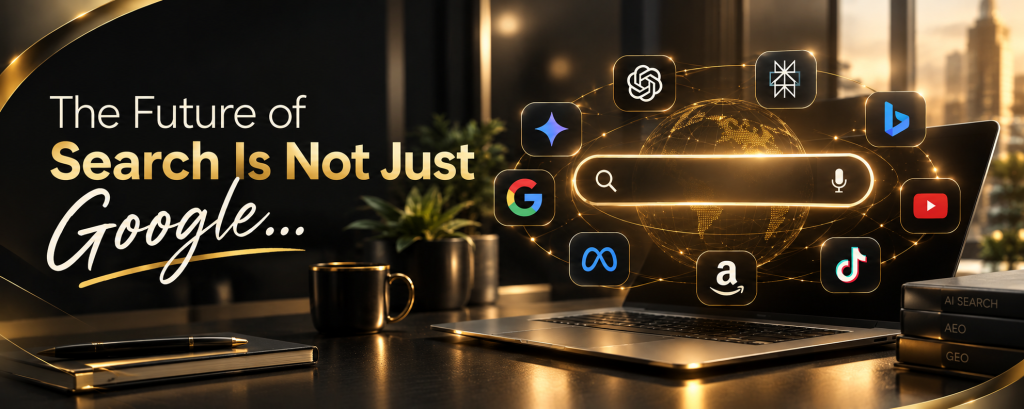
The Future of Search Is Not Just Google
The Future of Search Is Not Just Google How AI Assistants, Social Platforms and Conversational Search Are Changing the Way Customers Discover Businesses Search Is Changing A few years ago, finding a business almost always meant typing a few words into Google. That habit is still common, but it is no longer the only way people look for answers. Someone might ask a voice assistant for a nearby plumber, scroll through Instagram to find a new skincare brand, watch a YouTube review before buying a laptop, or ask an AI chatbot to compare two marketing agencies before picking up the phone. None of these habits replace Google entirely. They sit alongside it. A customer researching a service today may move between a search engine, a social app, a map, a review site, and a conversational AI tool within the same afternoon, often without thinking about which platform they are using at all. They are simply looking for a helpful, trustworthy answer, wherever it shows up first. For businesses, this shift matters. Ranking on page one of Google is still valuable, but it is no longer the entire picture. A business that only thinks about search engine rankings may miss the customers who are discovering brands through an AI assistant, a short video, or a recommendation shared in an online community. This blog looks at how discovery is changing, what businesses can realistically do about it, and where Google still fits into the bigger picture. Why Google Still Matters Before looking at everything that is changing, it is worth being clear about something important: Google is not disappearing. It remains one of the main ways people find websites, compare local services, and research products before buying. For many small businesses, a well-optimized Google Business Profile and a strong website are still the foundation of online visibility. Google continues to matter for local searches, such as someone looking for a dentist nearby or a restaurant open right now. It matters for product research, service comparisons, and for building long-term credibility, since a well-ranked website often signals trust to a visitor. Informational content, like guides and blog posts, still reaches a large audience through organic search. Good [Internal Link: SEO Services] work does not lose its value just because other discovery channels are growing. What is changing is the assumption that Google is the only channel worth investing in. It is becoming one important part of a much wider discovery ecosystem, rather than the entire ecosystem itself. Search Is Moving Beyond Traditional Search Engines Think about how differently people search today compared to a decade ago. A shopper might first see a product on Instagram, then look it up on Google to check reviews, and finally decide after watching a comparison video on YouTube. A person searching for a local service might ask a neighborhood Facebook group before typing anything into a search bar. Finding a product through an Instagram post or reel Watching a product review or tutorial on YouTube before buying Asking an AI assistant for a quick recommendation or comparison Finding a local service through Google Maps Reading real opinions in online communities or forums Discovering a company or professional through LinkedIn Using voice search to find something nearby while on the move Asking a conversational AI tool to compare two or three options Each of these is a genuine discovery moment. A business that only appears in traditional search results is invisible during many of these moments. This does not mean every business needs to be active everywhere. It means business owners should understand where their own customers actually spend time researching, and make sure the business can be found and understood there too. The Rise of AI-Powered Search AI-powered search tools work differently from a traditional results page. Instead of returning ten blue links, many of these tools generate a written, conversational answer, often drawing on multiple sources and summarizing them for the user. A person can then ask a follow-up question, the same way they might continue a conversation with a knowledgeable friend. Conversational, natural-language questions instead of short keyword phrases Summarized answers that pull information together instead of listing separate links Follow-up questions that build on the previous answer Context-based recommendations based on what was already discussed Multi-step research done inside a single conversation Comparison-based queries, such as asking which option fits a specific situation It is worth being honest here: different AI systems work in different ways, and no one outside those companies knows every detail of how they select or summarize information. What can be said generally is that these systems tend to favor content that is clear, well-organized, and directly useful to the question being asked. There is no single, universal method that works identically across every AI platform. How AI Assistants Can Influence Brand Discovery People are increasingly comfortable asking AI assistants questions that once would have gone straight into a Google search bar, such as: “Which digital marketing agency is suitable for a small business?” “What are the best SEO agencies for local businesses?” “Which website development company should I consider?” “What should I check before hiring a marketing agency?” When an AI assistant answers a question like this, it is generally working from a mix of publicly available information, including websites, third-party mentions, and other content it can access. This makes a few things genuinely useful for a business to focus on: Clear, accurate business information across the web Consistent brand details, so the same facts appear everywhere Helpful website content that actually answers common questions Reliable third-party references, such as directories and industry sites Relevant, honest online mentions from other sources Genuinely positive customer experiences that get talked about Strong topical authority built through consistent, useful content Accurate, complete business profiles across platforms Trustworthy content that does not exaggerate or mislead It is important to be direct about one thing: no business can guarantee that an AI assistant will mention it, recommend it, or rank it above a
How AI Decides Which Brands Deserve to Be Mentioned
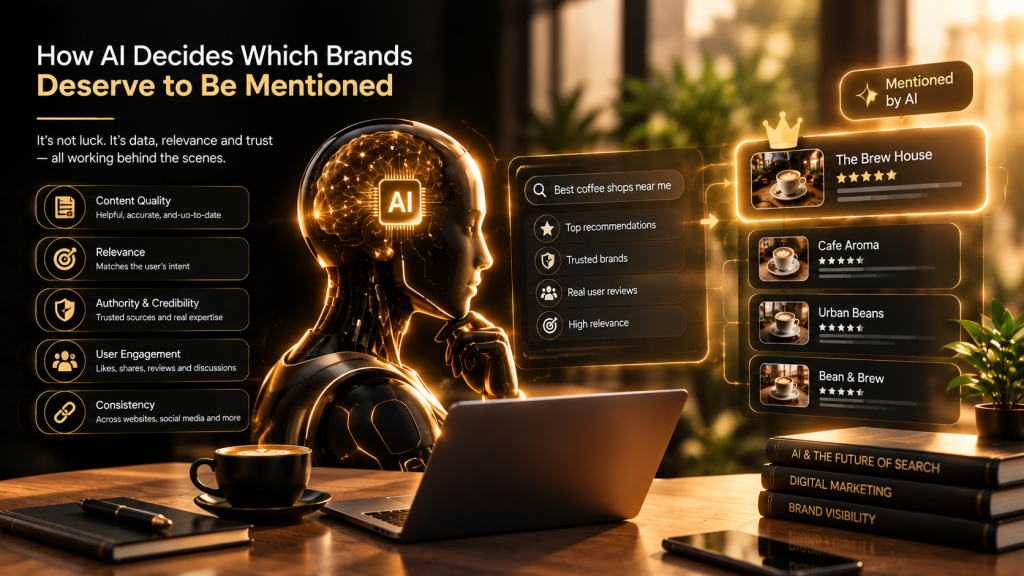
How AI Decides Which Brands Deserve to Be Mentioned A customer opens an AI assistant and types a simple question: “What are the best digital marketing agencies for a small business?” What comes back isn’t a page of ten blue links. It’s a short, confident answer — names, comparisons, sometimes a recommendation. No rankings page. No scrolling. Just an answer. That shift raises an obvious question for anyone running a business today: why does the AI mention some brands and not others? Is there a formula? A trick? A ranking system hiding behind the interface? The honest answer is more nuanced than most marketing content admits. AI-powered discovery isn’t a single ranking for a single keyword. It’s closer to a process of understanding — the system needs to grasp what a brand is, who it serves, and whether it’s genuinely relevant to the question being asked. There is no publicly confirmed universal formula that guarantees a mention, and anyone claiming otherwise is selling something. What this article does instead is walk through the factors that reasonably influence whether a brand gets understood, considered, and mentioned — and just as importantly, what’s genuinely outside a business’s control. If you run a business, manage marketing, or advise clients on visibility, this is the difference between chasing hacks and building something that actually holds up. What Does It Mean When AI Mentions a Brand? Being mentioned by an AI system is not the same as ranking #1 on Google. It’s a different kind of visibility entirely. When an AI system names a brand in response to a question, it’s typically drawing on some combination of: Brand recognition — does enough information exist to identify this business as a distinct entity? Relevance to the question — does the brand actually relate to what the user asked? Contextual association — is the brand connected to the right industry, service, or location? Available online information — is there enough content, in enough places, to describe the brand accurately? Reputation signals — reviews, mentions, and general sentiment attached to the brand Supporting evidence — sources that back up claims about what the brand does and how well it does it Entity understanding — whether the brand is recognized as a clear, singular “thing” rather than a vague or inconsistent presence A mention is not a permanent status. A brand might be highly relevant to one question and completely irrelevant to the next. A local bakery might be a strong answer to “best bakery in town” and have zero relevance to “best CRM software for startups.” That’s not a flaw in the system — it’s exactly how relevance is supposed to work. Does AI Have a “Brand Ranking Formula”? Direct answer: No single universal, public formula exists that guarantees a brand will be mentioned by an AI system. Different AI-powered search and conversational tools run on different models, different retrieval methods, and different combinations of data sources. What influences one system’s output may not influence another’s in the same way, and these systems continue to evolve. This matters because it’s easy to fall for a pitch that sounds like: “Follow these five exact steps and ChatGPT will always mention your brand.” That kind of promise should raise a flag immediately. Nobody outside the companies building these systems has verified access to their internal mechanics, and even employees of those companies would be cautious about describing a fixed, guaranteed process. What’s useful to separate here: Known best practices — things consistently associated with better visibility across search and AI systems (clarity, consistency, authority) Reasonable optimization strategies — structuring content and information in ways that make a brand easier to understand Industry observations — patterns marketers and researchers have noticed, without claiming certainty Speculation about proprietary systems — guesses about internal algorithms that should be treated with real skepticism The rest of this article stays firmly in the first three categories. Relevance Comes First Before authority, before reputation, before anything else — relevance is the foundation. If someone asks an AI system, “Which accounting software is useful for small businesses?” a fashion brand has no reasonable path into that answer, no matter how strong its marketing is. Relevance isn’t about being generally impressive. It’s about being connected to the actual subject at hand. Building that connection means strengthening the association between a brand and: Its industry Its specific services or products The audience it serves The problems it solves The topics it’s genuinely knowledgeable about The locations it operates in, where geography matters This is where focused, well-organized website content does real work. A business that clearly documents what it does, for whom, and where, gives both search engines and AI systems something concrete to work with. Vague, generic pages that could describe almost any company in the industry don’t build that connection — they blur it. Context Matters More Than a Single Keyword Traditional SEO trained a generation of marketers to think in terms of single keywords: rank for “marketing agency,” and the traffic follows. Modern AI-driven search behaves differently. It’s built to understand a user’s actual need, not just match words. Consider the difference between these questions: “best marketing agency” “best marketing agency for a local restaurant” “affordable SEO agency for a startup” “SEO agency that specializes in e-commerce” Each of these carries a different intent, and a brand that’s a strong answer to one might be a poor answer to another. An agency that primarily serves e-commerce clients has a real advantage when the question mentions e-commerce specifically — not because it “ranks higher,” but because its actual specialization matches the actual need being expressed. This is a meaningful shift for businesses to internalize: broad, generic positioning (“we do marketing for everyone”) is harder for both people and AI systems to match to a specific need than clear, specific positioning (“we do SEO and content for e-commerce brands”). How AI Understands What Your Brand Does AI systems don’t have a private meeting with your business to
The Difference Between Being Searchable and Being Discoverable
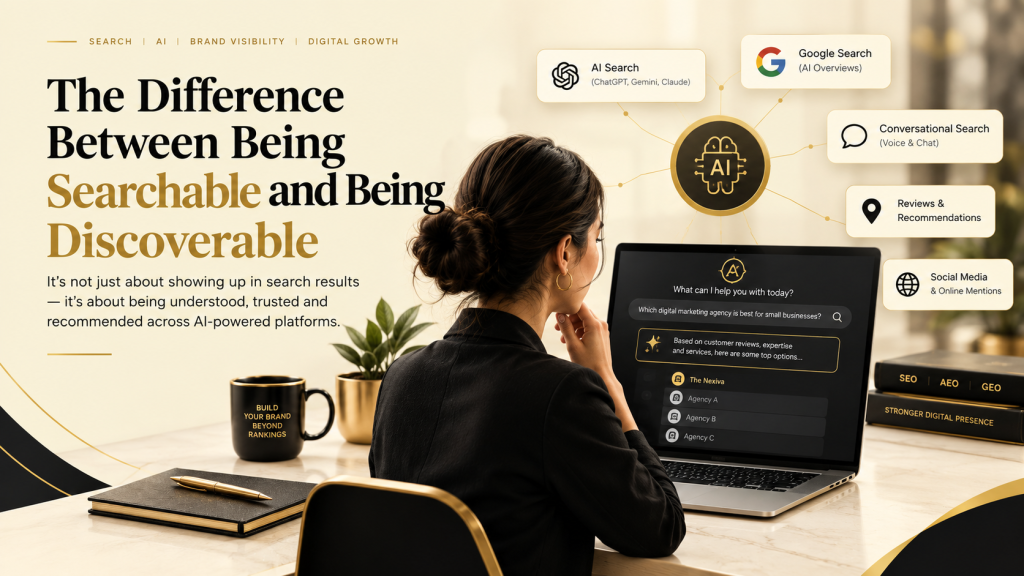
The Difference Between Being Searchable and Being Discoverable Ranking on Google used to be the whole strategy. Today, customers ask questions, use AI assistants, and compare options before they ever click a result. Here’s the real difference between showing up — and being understood, considered and recommended. Talk to THE NEXIVA For years, the only question that mattered in digital marketing was simple: “How do I rank on Google?” Businesses built entire strategies around keywords, backlinks and page one positions. That question hasn’t disappeared, but it’s no longer the whole story. Today, a customer might type a question into Google, ask an AI assistant for a recommendation, search inside a marketplace app, scroll through reviews, or ask a chatbot to compare three companies side by side before ever visiting a website. Somewhere in that mix, a business can rank perfectly well and still never enter the conversation. That’s the gap between two ideas that sound similar but aren’t: being searchable and being discoverable. Being searchable means people can find you if they know roughly what to look for. Being discoverable means the right people encounter your brand, understand why you matter, and consider you — even when they didn’t search for your business by name. One is about visibility in a results page. The other is about being understood well enough, by both humans and the systems humans now rely on, to be recommended. This article breaks down what each term actually means, why the difference matters more than it used to, and what a business can realistically do about it — without chasing shortcuts or unsupported promises about “guaranteed AI visibility.” What Does “Searchable” Actually Mean? Searchable simply means a business can be found through a search query. Your website exists, it’s indexed by search engines, and it shows up when someone types a relevant term into the search bar. Searchability is built on familiar mechanics: Search engine indexing — Google and other engines have crawled and stored your pages Keywords — your content includes the words and phrases people actually type Search rankings — where your pages land on the results page for those terms Organic visibility — how often and how prominently you appear without paid ads Website pages — service pages, landing pages, blog posts that match specific queries Search intent matching — your content lines up with what the searcher is trying to accomplish Here’s a practical example. A plumbing company in Austin might rank in the top five results for “emergency plumber Austin.” That’s real, valuable searchability — it captures people who already know exactly what they need and how to phrase it. But searchability has a ceiling. It only works when someone searches in a way your content is optimized to answer. It says nothing about whether that person trusts you over the next result, whether an AI assistant would mention you in a recommendation, or whether someone asking a broader question — “who’s a reliable plumber for an older home?” — would ever see your name at all. A business can be technically searchable and still be functionally invisible to a large share of its potential customers. What Does “Discoverable” Mean? Discoverability is the broader, deeper quality of being easy to find, understand, and recommend — across more than one channel and more than one type of query. A discoverable brand doesn’t just appear in results. It gets referenced, compared, and suggested because the surrounding digital ecosystem — its website, reviews, mentions, content and reputation — gives a clear, consistent picture of who it is and who it’s right for. A genuinely discoverable business tends to be: Easy to understand within seconds of encountering it Clearly relevant to specific customer needs, not just broad categories Present across multiple useful sources, not only its own website Clearly associated with specific products, services or specialties Consistently represented — same name, story and details everywhere Backed by content that actually answers real questions Supported by genuine reviews, mentions and third-party references Structured in a way that’s easy for modern search systems to interpret In simple terms: searchability gets you onto the field. Discoverability determines whether you’re actually in the game when someone is trying to make a decision. Searchable vs. Discoverable: What Is the Difference? Factor Searchable Discoverable Primary goal Appear in search results Be understood, considered and recommended Search behavior Matches specific keyword queries Matches broader questions, comparisons and needs Keywords Central to visibility One input among many signals Content Optimized for target terms Answers real questions with genuine depth Brand understanding Not required Central requirement AI visibility Not addressed Directly relevant Customer journey Often a single search-and-click Spans multiple touchpoints and sources Online mentions Not necessary Meaningfully contributes Reviews Not a ranking requirement Reinforces trust and relevance Entity signals Minimal role Helps systems understand who you are Context Page-level Brand-level, across the web Recommendations Rare outcome Core outcome Long-term visibility Vulnerable to algorithm shifts More resilient, built on consistent presence Notice the pattern: searchability is largely about a page matching a query. Discoverability is about a brand matching an understanding — one that’s built up from many sources over time. A Business Can Be Searchable But Still Not Discoverable Consider a local digital marketing agency. It ranks respectably for “SEO services [city name].” That’s solid, hard-won searchability. But when someone asks a more natural, conversational question — “which digital marketing agency is best for helping a small business build an online presence?” — that same agency may never come up. Not necessarily because it’s a worse agency, but because the broader ecosystem of information about it doesn’t clearly answer that specific, more open-ended question. There could be several reasons, and it’s worth being honest that no one outside a given platform can say with certainty exactly how any AI system weighs these factors: Its content may focus narrowly on service keywords rather than the underlying customer problem It may have limited mentions or reviews beyond its own website Its positioning — who
Your Customers Are Asking AI About Your Brand — What Does It Say?
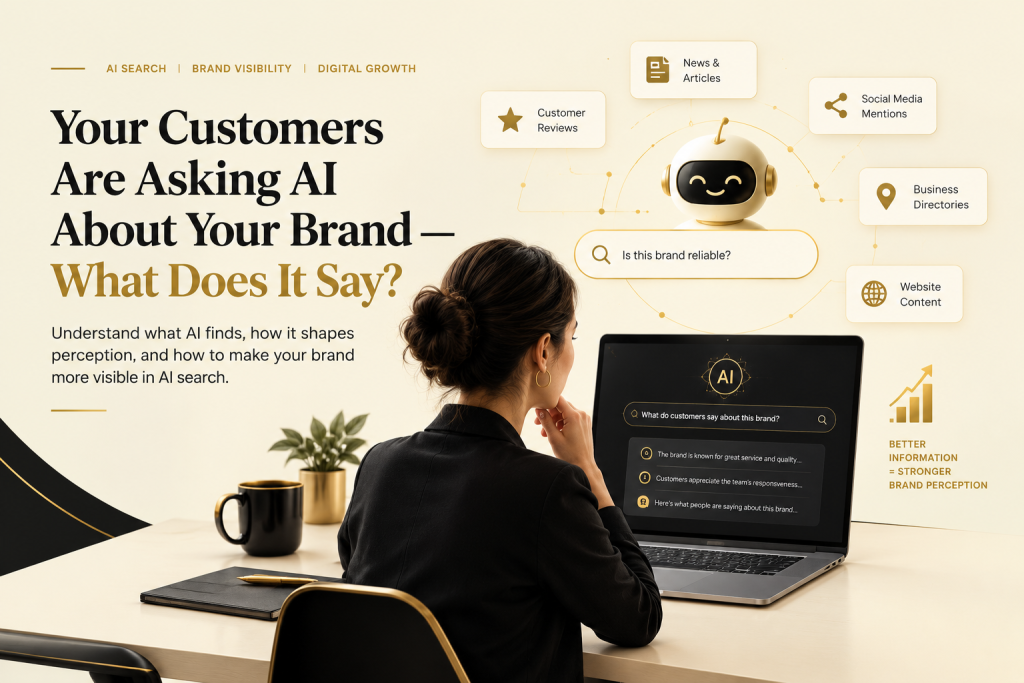
AI SEARCH & BRAND VISIBILITY Your Customers Are Asking AI About Your Brand — What Does It Say? A few years ago, someone researching a business typed something like “best digital marketing agency near me” into a search bar and scrolled through ten blue links. That habit hasn’t disappeared, but it’s no longer the whole story. Increasingly, that same person opens an AI assistant and asks a question instead of a keyword: “Which digital marketing agencies are good for small businesses?” “Is [brand] worth hiring?” “What does [brand] specialize in?” “What are customers saying about [brand]?” “How does [brand] compare with its competitors?” The answer they get back isn’t a list of links they have to click through. It’s a summary — a synthesized impression of who you are, what you do, and whether you’re worth their time. That leads to the question this article is built around: if customers are asking AI about your business, what information is AI finding, and what impression does that information create? This isn’t about chasing a new algorithm or trying to “win” a specific AI platform. It’s about understanding that your brand now has a reputation that lives partly outside your control, shaped by information scattered across the web, and learning how to influence it responsibly. Your Brand Has an AI Reputation Now Every business has always had a reputation that existed outside its own marketing — word of mouth, reviews, press mentions, what a competitor’s salesperson says about you in a pitch meeting. AI search and AI assistants have simply added a new, faster layer to that same phenomenon. When someone asks an AI system about your company, it draws on whatever it can find or recall, then presents that as a coherent answer. That answer is built from a patchwork of signals, not a single dossier. Depending on the system, a customer might be encountering information that originated from: Traditional search engines and the pages they index AI-powered search tools and assistants Review platforms like Google Business Profile, Yelp, or industry-specific review sites Social media profiles and posts Business directories and listing sites News websites and press coverage Industry publications and trade press Forums, communities, and Q&A sites Your own website and published content No single source tells the whole story on its own. What matters is whether these sources, taken together, paint a consistent and accurate picture. When they don’t, the gap gets filled by inference — and inference is where inaccuracies creep in. What Are Customers Actually Asking AI About Your Business? Direct answer: customers are mostly asking the same questions they’ve always asked a knowledgeable friend before buying something — they’re just asking an AI system instead. Understanding those question types helps you decide what your website and online presence need to answer clearly. Discovery Questions “Who offers this service?” — the customer doesn’t know your brand yet; they’re looking for options. Trust Questions “Is this company reliable?” — they’ve found you, and now they’re checking whether you’re legitimate. Comparison Questions “Which company is better for this?” — they’re weighing you against alternatives. Pricing Questions “How much does this service usually cost?” — they want a ballpark before reaching out. Reputation Questions “What do people say about this business?” — they’re looking for social proof. Expertise Questions “Does this company specialize in my industry?” — they want relevance, not just capability. Local Questions “What are the best businesses for this service in [location]?” — geography still matters, even in AI search. Most businesses only prepare answers for the first category — discovery. Trust, comparison, pricing, reputation, expertise, and local relevance are usually left to chance, scattered across whatever third parties happen to have written. Anticipating all seven categories, and answering them clearly across your website and online profiles, is the foundation of AI-ready visibility. Where Does AI Get Information About Your Brand? Different AI-powered search systems and AI assistants use different retrieval, ranking, training, browsing, and indexing methods. Some browse the live web in response to a question. Some rely on information absorbed during training. Some blend both, and lean on structured data or licensed content partnerships. There isn’t one universal system, and no single platform necessarily uses every source listed below — but these are the categories of information that can plausibly feed into an AI-generated answer about a business: Your business website and its published pages Publicly available web pages that reference your company Traditional search engine results Business profiles on platforms like Google Business Profile Customer reviews across review sites News coverage and press mentions Industry websites and trade publications Social media profiles Business directories and listings Structured data (schema markup) on your site Public discussions on forums and community platforms Other sources the specific AI system considers authoritative The practical takeaway isn’t to chase every platform’s exact methodology — that information changes and isn’t always public. It’s to make sure that wherever information about your business does exist, it’s accurate, current, and tells the same story. What Happens When the Information About Your Brand Is Incomplete? Picture a business whose website lists three services, whose Google Business Profile lists five, whose LinkedIn page describes a slightly different focus, and whose most recent press mention is three years old and references a service the company no longer offers. None of this is a scandal. It’s just noise — and noise makes it harder for anyone, human or automated, to form a clear picture. Common gaps that create this kind of noise include: Missing information about services, locations, or specializations Outdated details about pricing, hours, or offerings Conflicting business details across different platforms Weak or vague service descriptions Thin or poorly structured website content Unclear positioning — what you do and who you do it for A lack of authoritative third-party mentions Limited or old customer reviews Outdated directory and profile listings None of these inconsistencies guarantee that an AI system will misrepresent you, exclude you, or rank you differently — that would be an
How to Make Your Business Visible in AI Search?
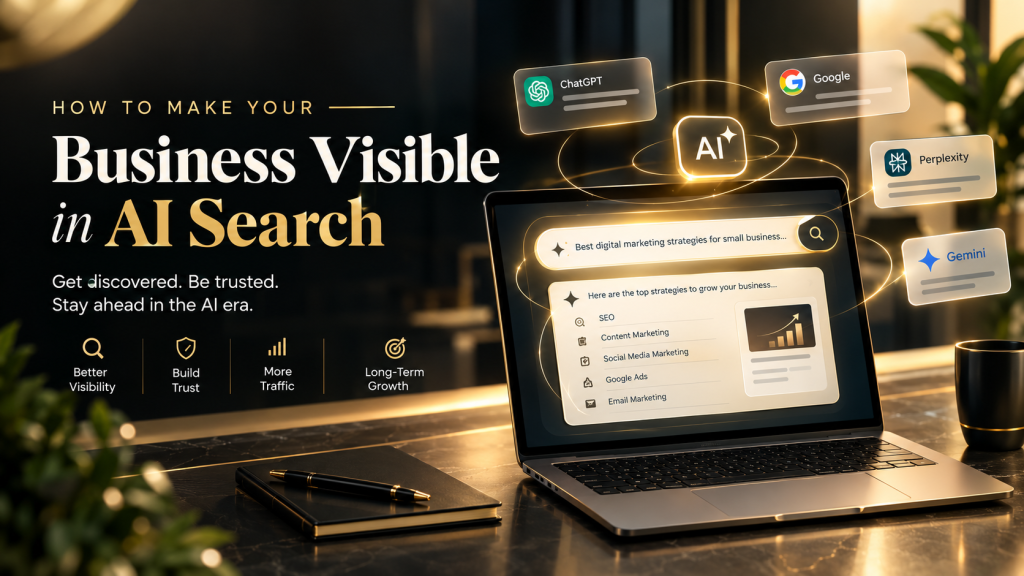
How to Make Your Business Visible in AI Search A practical guide to SEO, AEO & GEO for modern businesses For years, the question businesses asked about search was simple: “Which websites rank on page one?” That question hasn’t disappeared, but a new one has joined it: “Which businesses, sources, and brands does AI consider trustworthy enough to mention?” People are increasingly typing questions into ChatGPT, Google’s AI Overviews, Perplexity, Copilot, and voice assistants instead of scrolling through ten blue links. They’re asking things like “What’s the best CRM for a five-person sales team?” or “Who does affordable bookkeeping for freelancers in Austin?” and getting a synthesized answer, sometimes with a few sources cited, sometimes with none at all. This doesn’t mean traditional search is dying. Google, Bing, and organic rankings still drive enormous amounts of traffic, and they remain the foundation that most AI systems build on. But a growing share of research, comparison, and decision-making now happens inside conversational, AI-generated answers — and if your business isn’t part of the information those systems draw from, you’re invisible in a channel that’s only going to matter more. This guide walks through what AI search actually is, how it’s different from traditional search, and what you can realistically do to improve your odds of being found, understood, and mentioned by AI systems. What Is AI Search? AI search refers to search and discovery experiences that use generative AI to produce direct, synthesized answers instead of (or alongside) a traditional list of links. This includes: Generative search — AI-generated summaries that pull from multiple sources, like Google’s AI Overviews Conversational search — back-and-forth question answering, like ChatGPT or Perplexity AI assistants — voice and chat assistants that answer questions directly, often without showing sources at all Hybrid search experiences — traditional results pages with AI-generated summaries layered on top The core shift is from retrieval to synthesis. Traditional search retrieves and ranks pages, leaving the user to click through and read. AI search reads multiple sources, extracts what it judges to be the most relevant and reliable information, and presents a condensed answer — sometimes citing sources, sometimes just stating the answer as fact. That difference matters enormously for businesses. If AI systems summarize information instead of sending a visitor to your website, your visibility increasingly depends on whether you’re part of the source material the AI draws from — not just whether you rank. Why AI Search Visibility Matters for Businesses Businesses that ignore AI search visibility risk becoming invisible at exactly the moment a potential customer is deciding what to buy or who to hire. A few reasons this matters in practice: Zero-click discovery. A user asking an AI assistant “what’s a good project management tool for a small design agency” may never see a search results page at all. If your product isn’t part of the answer, you never had a chance. Research-stage influence. Buyers frequently use AI tools to compare options before they ever visit a website. Being mentioned during that comparison stage shapes the shortlist before you get a chance to make your own pitch. Trust transfer. When an AI system mentions a business by name, it often carries an implicit stamp of credibility — similar to being mentioned in a respected publication. Local relevance. Someone asking “which plumber near me has good reviews” through a voice assistant is making a real-time purchase decision, not just browsing. Competitive exposure. If your direct competitors are being mentioned in AI answers and you aren’t, that’s a competitive gap, not just a marketing inconvenience. None of this means SEO no longer matters — it means the finish line has moved. Ranking well is still valuable, but the businesses that also show up in AI-generated answers get a second, increasingly important, form of visibility. How AI Search Finds and Understands Businesses There’s no single “AI ranking algorithm,” and it’s worth being honest about that upfront. Different platforms — Google, OpenAI, Microsoft, Perplexity, and others — use different retrieval systems, training data, and real-time web access methods. What they tend to have in common is that they draw on a mix of signals rather than one dominant factor: Website content that’s crawlable and clearly written Structured data that helps machines parse what a page is about Consistent business information across the web (name, description, location, category) Brand mentions in independent, credible sources Reviews and reputation signals from customers and third parties Industry and news coverage that corroborates what a business claims about itself Topical relevance and depth — how thoroughly a business covers its subject area Entity relationships — how a business connects to other recognized entities (industries, locations, people, products) The practical takeaway: AI systems form an impression of your business the way a thorough researcher would — by cross-referencing multiple sources, not by reading a single optimized landing page. That means visibility is earned across your entire digital footprint, not just your homepage. SEO vs AEO vs GEO These three terms get used loosely, so it helps to separate them clearly. They overlap significantly — they aren’t competing strategies, they’re complementary lenses on the same underlying goal: being found, understood, and trusted. SEO (Search Engine Optimization) is the practice of improving a website’s visibility in traditional search engine results through technical performance, relevance, and authority signals. AEO (Answer Engine Optimization) is the practice of structuring content so it can directly and clearly answer specific questions, making it more likely to be surfaced in featured answers, voice search, and question-based results. GEO (Generative Engine Optimization) is the practice of improving how clearly and credibly a business can be discovered, understood, and potentially referenced within generative AI search experiences — focusing on entity clarity, topical authority, and third-party corroboration rather than rankings alone. Factor SEO AEO GEO Primary goal Rank in search results Get selected as a direct answer Get mentioned or referenced by generative AI Core unit Web pages Specific questions/answers Entities and topics Key signals Backlinks, technical performance,
Uncategorized
Hello world!
Welcome to WordPress. This is your first post. Edit or delete it, then start writing!