The Future of Search Is Not Just Google
How AI Assistants, Social Platforms and Conversational Search Are Changing the Way Customers Discover Businesses
Search Is Changing
A few years ago, finding a business almost always meant typing a few words into Google. That habit is still common, but it is no longer the only way people look for answers. Someone might ask a voice assistant for a nearby plumber, scroll through Instagram to find a new skincare brand, watch a YouTube review before buying a laptop, or ask an AI chatbot to compare two marketing agencies before picking up the phone.
None of these habits replace Google entirely. They sit alongside it. A customer researching a service today may move between a search engine, a social app, a map, a review site, and a conversational AI tool within the same afternoon, often without thinking about which platform they are using at all. They are simply looking for a helpful, trustworthy answer, wherever it shows up first.
For businesses, this shift matters. Ranking on page one of Google is still valuable, but it is no longer the entire picture. A business that only thinks about search engine rankings may miss the customers who are discovering brands through an AI assistant, a short video, or a recommendation shared in an online community. This blog looks at how discovery is changing, what businesses can realistically do about it, and where Google still fits into the bigger picture.
Why Google Still Matters
Before looking at everything that is changing, it is worth being clear about something important: Google is not disappearing. It remains one of the main ways people find websites, compare local services, and research products before buying. For many small businesses, a well-optimized Google Business Profile and a strong website are still the foundation of online visibility.
Google continues to matter for local searches, such as someone looking for a dentist nearby or a restaurant open right now. It matters for product research, service comparisons, and for building long-term credibility, since a well-ranked website often signals trust to a visitor. Informational content, like guides and blog posts, still reaches a large audience through organic search.
Good [Internal Link: SEO Services] work does not lose its value just because other discovery channels are growing. What is changing is the assumption that Google is the only channel worth investing in. It is becoming one important part of a much wider discovery ecosystem, rather than the entire ecosystem itself.
Search Is Moving Beyond Traditional Search Engines
Think about how differently people search today compared to a decade ago. A shopper might first see a product on Instagram, then look it up on Google to check reviews, and finally decide after watching a comparison video on YouTube. A person searching for a local service might ask a neighborhood Facebook group before typing anything into a search bar.
- Finding a product through an Instagram post or reel
- Watching a product review or tutorial on YouTube before buying
- Asking an AI assistant for a quick recommendation or comparison
- Finding a local service through Google Maps
- Reading real opinions in online communities or forums
- Discovering a company or professional through LinkedIn
- Using voice search to find something nearby while on the move
- Asking a conversational AI tool to compare two or three options
Each of these is a genuine discovery moment. A business that only appears in traditional search results is invisible during many of these moments. This does not mean every business needs to be active everywhere. It means business owners should understand where their own customers actually spend time researching, and make sure the business can be found and understood there too.
The Rise of AI-Powered Search
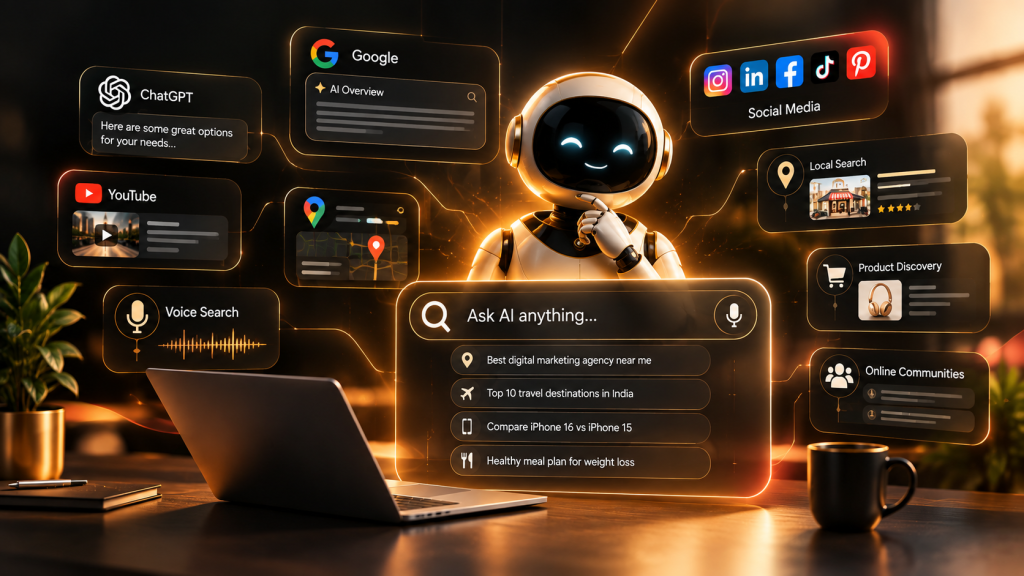
AI-powered search tools work differently from a traditional results page. Instead of returning ten blue links, many of these tools generate a written, conversational answer, often drawing on multiple sources and summarizing them for the user. A person can then ask a follow-up question, the same way they might continue a conversation with a knowledgeable friend.
- Conversational, natural-language questions instead of short keyword phrases
- Summarized answers that pull information together instead of listing separate links
- Follow-up questions that build on the previous answer
- Context-based recommendations based on what was already discussed
- Multi-step research done inside a single conversation
- Comparison-based queries, such as asking which option fits a specific situation
It is worth being honest here: different AI systems work in different ways, and no one outside those companies knows every detail of how they select or summarize information. What can be said generally is that these systems tend to favor content that is clear, well-organized, and directly useful to the question being asked. There is no single, universal method that works identically across every AI platform.
How AI Assistants Can Influence Brand Discovery
People are increasingly comfortable asking AI assistants questions that once would have gone straight into a Google search bar, such as:
- “Which digital marketing agency is suitable for a small business?”
- “What are the best SEO agencies for local businesses?”
- “Which website development company should I consider?”
- “What should I check before hiring a marketing agency?”
When an AI assistant answers a question like this, it is generally working from a mix of publicly available information, including websites, third-party mentions, and other content it can access. This makes a few things genuinely useful for a business to focus on:
- Clear, accurate business information across the web
- Consistent brand details, so the same facts appear everywhere
- Helpful website content that actually answers common questions
- Reliable third-party references, such as directories and industry sites
- Relevant, honest online mentions from other sources
- Genuinely positive customer experiences that get talked about
- Strong topical authority built through consistent, useful content
- Accurate, complete business profiles across platforms
- Trustworthy content that does not exaggerate or mislead
It is important to be direct about one thing: no business can guarantee that an AI assistant will mention it, recommend it, or rank it above a competitor. These systems are built and controlled by outside companies, and their processes are largely proprietary. What a business can do is make itself easy to find, easy to understand, and easy to trust, which improves the odds without ever promising a specific outcome.
Social Media Is Becoming a Search Platform
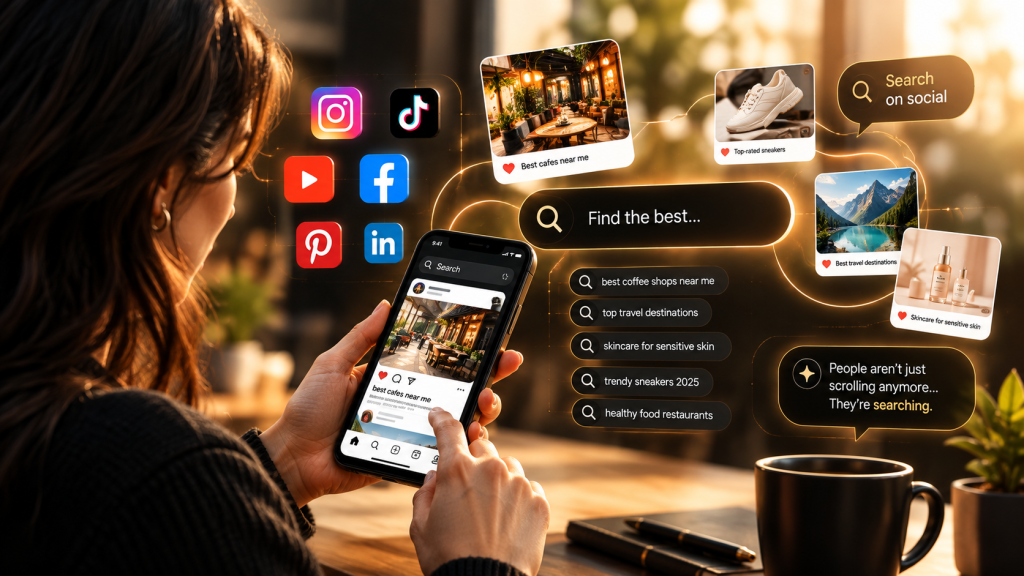
Many people now use social platforms the way they once used a search engine. Instead of Googling “best coffee shop near me,” someone might search that same phrase directly inside Instagram or TikTok, expecting to see real photos, videos, and recent posts.
- Products and where to buy them
- Restaurants and cafes worth visiting
- Local and professional services
- Honest reviews and first-hand experiences
- How-to tutorials and demonstrations
- Brands that match a certain style or values
- Creators and voices worth following
- Current trends in an industry
- Recommendations from real people
- Local businesses in a specific area
Platforms like Instagram, Facebook, LinkedIn, YouTube, and Pinterest each play a slightly different role. Instagram and Pinterest often support visual discovery, YouTube supports in-depth product research, LinkedIn supports B2B credibility, and Facebook still supports local community recommendations. [Internal Link: Social Media Marketing Services] can help a business figure out which of these platforms genuinely fits its audience.
To be found through social search, a profile needs a clear, complete description, along with captions and video titles that use natural, relevant language rather than stuffed keywords. Hashtags can help when used sparingly and honestly, but piling on dozens of unrelated tags tends to look spammy and rarely helps. Consistent branding, useful content, and genuine engagement matter far more than trying to game the algorithm.
Conversational Search and Voice Search
People rarely speak the way they type. Someone typing into Google might search for a short phrase, but the same person speaking to a voice assistant, or typing into a chat-based AI tool, tends to ask a complete, natural question. Compare these two examples:
Traditional search query:
“Best SEO agency Varanasi”
Conversational query:
“Which SEO agency can help a small business improve its local visibility and website traffic?”
The second version is longer, more specific, and closer to how a person actually speaks. This shift toward natural-language questions affects how content should be written. Long-tail phrases, question-based headings, and clear FAQ sections tend to match this style of search better than short, keyword-only content.
Businesses can prepare by writing content that directly answers real questions, using plain language instead of jargon, and organizing pages so that a reader (or an AI system scanning the page) can quickly find the specific answer they need. Local intent still matters here too, since many voice and conversational searches are made while people are out and about, looking for something nearby right now.
The Growth of Zero-Click Search
A zero-click search happens when a person gets the answer they need without ever clicking through to a website. This can happen through a featured snippet, a map result, a knowledge panel, an AI-generated summary, a social media caption, or a spoken answer from a voice assistant.
- Search engine features, such as snippets and knowledge panels
- Map results showing hours, ratings, and directions
- AI-generated summaries that answer a question directly
- Social platforms showing an answer within a post or caption
- Voice assistants reading out a short spoken answer
- Business listings that show contact details at a glance
Zero-click results can feel frustrating for a business that measures success only in website visits, since the user gets an answer without ever landing on the site. At the same time, being the source of that answer, even without a click, still builds recognition and trust. A business that keeps showing up with accurate, helpful information tends to be remembered when the person is finally ready to make a decision. The effect of zero-click search is not identical for every business; it depends heavily on the industry and the type of question being asked.
Why Businesses Need a Multi-Platform Presence
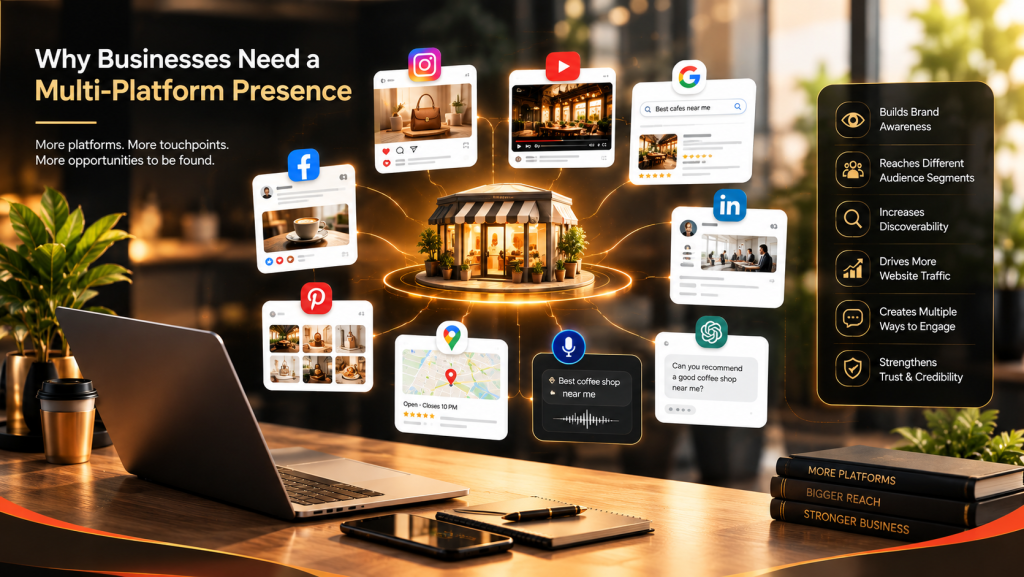
Relying on a single platform is risky. An algorithm update, a policy change, or a shift in user behavior can quietly reduce visibility overnight. A broader presence across a website, Google Business Profile, relevant social platforms, directories, review sites, and industry-specific websites spreads that risk out and creates more chances to be discovered.
What matters even more than simply being present everywhere is being consistent. The business name, services offered, contact information, website address, description, location, and overall brand message should match across every platform. When these details conflict, for example, an old phone number on one directory and a new one on the website, it creates confusion and can quietly damage trust, both with customers and with the systems trying to understand the business.
SEO, AEO, and GEO: What Is the Difference?
These three terms are related, but they are not the same thing. Search Engine Optimization (SEO) focuses on improving visibility in traditional search engines like Google, using techniques such as keyword research, technical performance, and quality content.
Answer Engine Optimization (AEO) focuses on structuring content so it clearly and directly answers specific questions, which helps it get picked up in featured snippets, voice answers, and similar formats. Generative Engine Optimization (GEO) is a newer and less established idea, generally used to describe efforts to make information clearer, more credible, and more useful for generative AI systems to reference or summarize.
None of these should be treated as a guaranteed ranking system. AI platforms each use their own proprietary processes, and results can vary between one system and another, and even change over time on the same system. There is no universal formula that guarantees a brand mention or a specific position in AI-generated answers. The table below gives a simple, general comparison.
| Area | Main Focus | Common Content Format | Main Goal | Example |
|---|---|---|---|---|
| SEO | Traditional search engine visibility | Web pages, blogs, product pages | Rank for relevant keywords | Ranking for “local SEO agency” on Google |
| AEO | Directly answering specific questions | FAQs, how-to content, structured answers | Provide a clear, usable answer | Answering “what is a Google Business Profile” in one clear paragraph |
| GEO | Clarity and credibility for generative AI systems | Well-structured, factual, well-referenced content | Be understandable and citable by AI tools | Being referenced when an AI assistant summarizes marketing agency options |
Ten Practical Ways to Prepare Your Business for the Future of Search
- Create clear and helpful website content. Write pages that genuinely help a visitor understand your services, pricing approach, and process, rather than pages built only to include keywords.
- Answer real customer questions. Look at the questions customers actually ask by phone, email, or chat, and turn the most common ones into website content.
- Strengthen topical authority. Cover your core subject area in depth over time, rather than publishing scattered, unrelated topics that dilute your expertise.
- Keep business information consistent. Check that your name, address, phone number, and services match across your website, Google Business Profile, and directories.
- Improve local search visibility. Complete your Google Business Profile fully, add real photos, and encourage genuine reviews from actual customers.
- Publish useful and original content regularly. A steady rhythm of original, helpful content tends to build more trust than occasional, thin posts.
- Optimize social media profiles. Make sure your bio, contact details, and pinned content clearly explain who you are and what you offer at a glance.
- Build genuine brand mentions and references. Earn mentions through real relationships, partnerships, guest content, and honest customer experiences, not artificial link schemes.
- Improve website experience and technical performance. A fast, mobile-friendly, secure, and easy-to-navigate website supports both human visitors and search systems.
- Track visibility across multiple discovery channels. Look beyond keyword rankings and review traffic sources, social engagement, and direct or branded searches together.
Make Your Website Ready for AI and Human Visitors
A website should be built for the people reading it first, and structured clearly enough that search and AI systems can understand it too. This means clear navigation, descriptive page titles, and headings that actually describe what is on the page, instead of vague or clever wording.
- Well-organized content with a logical flow
- Simple, plain language instead of heavy jargon
- Relevant internal links between related pages
- A genuinely helpful FAQ section
- Accurate, specific service pages
- Author information where it adds credibility
- Clear contact information
- An honest, informative About page
- Visible trust signals, such as real reviews or credentials
- Mobile responsiveness
- Fast loading times
- Accessible design for all users
- Secure browsing (HTTPS)
- Structured information, such as clear headings and lists, where appropriate
Websites written only to satisfy an algorithm tend to read awkwardly and lose the trust of real visitors quickly. The stronger approach is to write for the person on the other side of the screen, and let good structure and clarity naturally support search and AI visibility as well.
Measuring Visibility Beyond Traditional Rankings
Keyword rankings are only one signal, and on their own, they do not tell the whole story. A wider view of visibility might include organic traffic trends, branded searches (people searching for your business by name), direct traffic, and referral traffic from other sites.
- Organic traffic over time
- Branded search volume
- Direct traffic to the website
- Referral traffic from other sites and platforms
- Social media engagement
- Video views and watch time
- Profile visits on social and directory platforms
- Local actions, such as calls or direction requests
- Genuine enquiries received
- Qualified leads generated
- Website conversions
- Types of questions customers are asking
- Brand mentions across the web
- Overall content engagement
No single metric proves that a business is being mentioned inside AI-generated answers, since most platforms do not share that data directly. The most reliable approach is to look at several indicators together and interpret trends carefully, rather than treating one number as definitive proof.
Common Mistakes Businesses Should Avoid
- Depending only on Google — diversify visibility across other relevant platforms.
- Publishing low-quality content — focus on fewer, genuinely useful pieces instead of volume.
- Copying competitors — build content and positioning around your own real expertise.
- Using keyword stuffing — write naturally, for the person reading it.
- Creating fake reviews — this damages trust and can violate platform policies.
- Making unsupported claims — keep marketing language honest and verifiable.
- Ignoring social platforms — even a basic, accurate presence helps discovery.
- Keeping outdated business information — review listings and profiles regularly.
- Neglecting mobile users — most discovery now happens on a phone.
- Writing content only for search engines — prioritize the human reader.
- Expecting instant results — visibility across channels builds over time.
- Believing in guaranteed AI rankings — no provider can promise this honestly.
- Ignoring customer experience — word of mouth still shapes online reputation.
What Businesses Can Control—and What They Cannot
It helps to be realistic about where your effort actually makes a difference. Businesses can generally control:
- Website quality and clarity
- How genuinely useful their content is
- Consistency of brand information
- The customer experience they deliver
- Technical performance of their website
- The accuracy of their online profiles
- Reviews earned honestly, over time
- The accuracy of their content
- Their own social media activity
- How complete their business information is
On the other hand, businesses cannot fully control:
- What an AI system chooses to say or summarize
- How search engine algorithms change over time
- Which businesses a platform chooses to recommend
- What competitors do
- How individual users behave or make decisions
- How search results shift from one update to the next
- Whether a particular AI system mentions a specific brand at all
Any agency or consultant who promises guaranteed rankings, guaranteed AI mentions, or guaranteed featured snippets is making a promise they cannot honestly keep. The realistic goal is to strengthen everything within your control, consistently, over time.
The Future Belongs to Discoverable Brands
Future visibility will not depend on ranking for a single keyword. It will depend on how easily a brand can be found, understood, and trusted across many different touchpoints. Strong brands tend to become searchable, understandable, and consistent, wherever a customer happens to be looking.
- Searchable across multiple platforms
- Understandable, with clear and consistent messaging
- Trustworthy, backed by honest content and real experiences
- Useful, answering the questions customers actually have
- Consistent in how the brand presents itself
- Recognizable, with a clear identity
- Relevant across the platforms customers actually use
- Easy to recommend, both by people and by AI systems
- Helpful in the kinds of real conversations customers are having
The goal is not to try to appear everywhere at once. It is to show up with genuine value wherever your specific customers are actually looking for answers.
Frequently Asked Questions
Yes. Google remains one of the most important channels for local search, product research, and website traffic. It is not disappearing, but it is now one important part of a larger discovery landscape rather than the only channel that matters.
AI-powered search refers to tools that generate conversational, summarized answers to a question, often allowing follow-up questions, rather than only returning a list of website links.
People increasingly search directly inside platforms like Instagram, TikTok, and YouTube for products, services, reviews, and recommendations, often before or instead of using a traditional search engine.
SEO focuses on visibility in traditional search engines. AEO focuses on directly and clearly answering specific questions. GEO focuses on making content clear and credible for generative AI systems. They are related but not identical, and none of them guarantee a specific ranking or mention.
No. AI platforms use proprietary systems that are not publicly controlled, so no business or agency can honestly guarantee a mention, recommendation, or ranking in AI-generated answers.
By writing content in natural language that directly answers real customer questions, using clear headings, FAQ sections, and long-tail phrases instead of relying only on short keywords.
When your name, contact details, services, and location match across your website, listings, and social profiles, it reduces confusion and helps both customers and AI systems trust the information.
No. It is more effective to identify where your actual customers search and spend time, and build a genuine, well-maintained presence there, rather than spreading effort thin across every possible platform.
By tracking a mix of indicators together, such as branded searches, direct traffic, referral traffic, social engagement, enquiries, and content engagement, rather than relying on a single metric.
Clear, accurate, and genuinely useful website content remains one of the strongest foundations for visibility, whether a customer finds it through Google, a voice assistant, or an AI-generated summary.
Conclusion
Google still matters, and it will likely remain an important part of how customers find businesses for a long time to come. What has changed is the wider picture around it. AI assistants, social platforms, video content, maps, and conversational tools have all become genuine discovery channels in their own right, and customers are moving fluidly between all of them.
The businesses that adapt well will not be the ones chasing every new platform or making promises they cannot keep. They will be the ones that focus on being useful, clear, trustworthy, and easy to find, consistently, across a well-maintained online presence. No algorithm and no platform can be fully controlled, but a strong, honest, consistent foundation gives a business the best realistic chance of being discovered, wherever a customer happens to be looking.
THE NEXIVA works with small businesses, startups, and established brands to build that kind of foundation, through services including [Internal Link: SEO Services], [Internal Link: Social Media Marketing Services], [Internal Link: Content Marketing Services], [Internal Link: Google Ads Services], [Internal Link: Email Marketing Services], and [Internal Link: Website Development Services]. If you want a clearer, more consistent presence across the platforms your customers actually use, [Internal Link: About THE NEXIVA] is a good place to start the conversation.
Ready for a Search Strategy Built for What Comes Next?
Let’s build a stronger, more consistent presence across Google, social platforms, and AI-driven discovery.
SEO Information
SEO Title: The Future of Search Is Not Just Google | THE NEXIVA
Meta Description: Google still matters, but AI assistants, social platforms, and conversational search are changing how customers find businesses. Learn what your business can do to stay visible.
URL Slug: /future-of-search-not-just-google/
Primary Keyword: future of search
Secondary Keywords: AI search optimization, conversational search, generative engine optimization, answer engine optimization, search beyond Google, AI assistants and brand discovery, social media search, zero-click search, multi-platform visibility, SEO AEO GEO
Featured Snippet Answer: The future of search is not limited to Google because customers now discover businesses through AI assistants, social media, YouTube, voice search, and conversational tools as well. Search has expanded into a wider ecosystem, so businesses need visibility across multiple platforms, not just traditional search engine rankings.