
Uncategorized

Uncategorized

Your Content Is Speaking For Your Brand

Your Content Is Speaking for Your Brand — What Is It Saying? A THE NEXIVA Perspective on Content, Brand Perception & Trust Every time you publish something — a caption, a blog post, a product photo, an email, a website page — you’re not just sharing information. You’re speaking. And whether you realize it or not, your audience is listening closely, forming opinions about who you are, what you value, and whether you’re worth their trust. Most businesses think about content in terms of frequency: post more, rank higher, sell more. But content isn’t just a marketing task to check off a list — it’s a conversation. And like any conversation, the way you show up matters as much as what you actually say. If your content is inconsistent, generic, or careless, that’s exactly how your brand starts to feel in the eyes of your audience. If it’s thoughtful, valuable, and authentic, that’s what people begin to associate with you too. So here’s a question worth sitting with for a moment: what is your content actually saying about your brand right now? In short: Your content is a direct reflection of your brand. Every caption, page, email, and post either builds trust and recognition, or quietly chips away at it. Businesses that treat content as a strategic brand asset — not just a promotional tool — build stronger, more memorable, more trusted brands over time. What Does Your Content Communicate About Your Brand? Whether you intend it to or not, every piece of content you publish sends a message. It’s rarely just about the product feature you’re describing or the offer you’re promoting — it’s about the impression left behind. Content constantly signals things like: Your professionalism and attention to detail The values and priorities your business stands for The quality customers should expect from working with you Whether you genuinely understand your audience’s needs How trustworthy and credible your brand actually is Your personality and tone — serious, playful, premium, approachable None of this is accidental, even when it looks that way. A rushed caption, a stock photo that doesn’t match your brand, or a blog post stuffed with keywords instead of real answers — these all say something too, just not something you’d choose on purpose. Your Content Shapes First Impressions For most people today, the first “meeting” with your brand doesn’t happen in a store or on a sales call — it happens through content. A search result. A social media post. A homepage. An ad on their feed. Research on user behavior consistently shows that people form an opinion about a website or profile within seconds, long before they read a single sentence in detail. Layout, tone, imagery, and clarity all register almost instantly. Think about the difference between landing on a website with outdated design, cluttered text, and broken formatting — versus one that’s clean, purposeful, and easy to navigate. Or scrolling through an Instagram grid with mismatched fonts and inconsistent captions, compared to one that feels curated and intentional. In both cases, you form a judgment about credibility before you’ve evaluated a single product or service. That first impression is often the deciding factor in whether someone stays to learn more — or quietly moves on to a competitor. How Different Types of Content Speak for Your Brand Brand perception isn’t shaped by one type of content — it’s built across every touchpoint. Here’s what each major content format is really communicating. Website Content Your website is often the most detailed conversation you’ll ever have with a potential customer without speaking to them directly. Clear messaging, well-organized pages, and thoughtful copy say “we know what we’re doing.” Confusing navigation, outdated information, or vague service pages say the opposite — even if your actual work is excellent. Social Media Content Social platforms are where personality shows. Consistent visuals, a recognizable tone, and captions that add value build familiarity and trust over time. Random, disconnected posts with no clear voice make a brand forgettable, no matter how often it posts. Blog Content Blogs are one of the clearest signals of expertise. A blog that genuinely answers questions, explains concepts, and offers real insight builds authority. A blog that exists purely to insert keywords, with thin or repetitive content, signals the opposite — and search engines are increasingly good at telling the difference too. Email Marketing Email is a direct line to your audience’s inbox, which makes it personal. Relevant, well-timed, valuable emails build a relationship. Generic, overly frequent, purely promotional emails train people to stop opening — or to unsubscribe altogether. Visual Content Photos, graphics, and videos communicate before words even register. Consistent colors, quality imagery, and a recognizable style build visual trust. Low-effort or mismatched visuals — even paired with great copy — can undercut the credibility of everything around them. Advertising Content Ads are often a brand’s most public and repeated impression. Thoughtful, honest, well-targeted ads build recognition and trust over multiple exposures. Misleading claims, poor targeting, or overly aggressive sales language can create skepticism that outlasts the campaign itself. What Does Your Current Content Say About Your Brand? Before making changes, it helps to honestly audit where things stand today. Ask yourself: Would a stranger understand what we do within the first few seconds of visiting our website or profile? Does our content look and sound consistent across our website, social media, and emails? Are we providing real value, or mostly just promoting ourselves? Does our visual identity feel intentional, or randomly assembled? Would our content make someone trust us more, or feel unsure? If a competitor’s content and ours were placed side by side, which one would a customer choose? There are no perfect scores here. The goal is simply to see your content the way your audience does — because they’re already forming these judgments, whether you’re asking these questions or not. Common Content Mistakes That Can Damage Brand Perception Most brand-damaging content isn’t the result of a single bad

Uncategorized

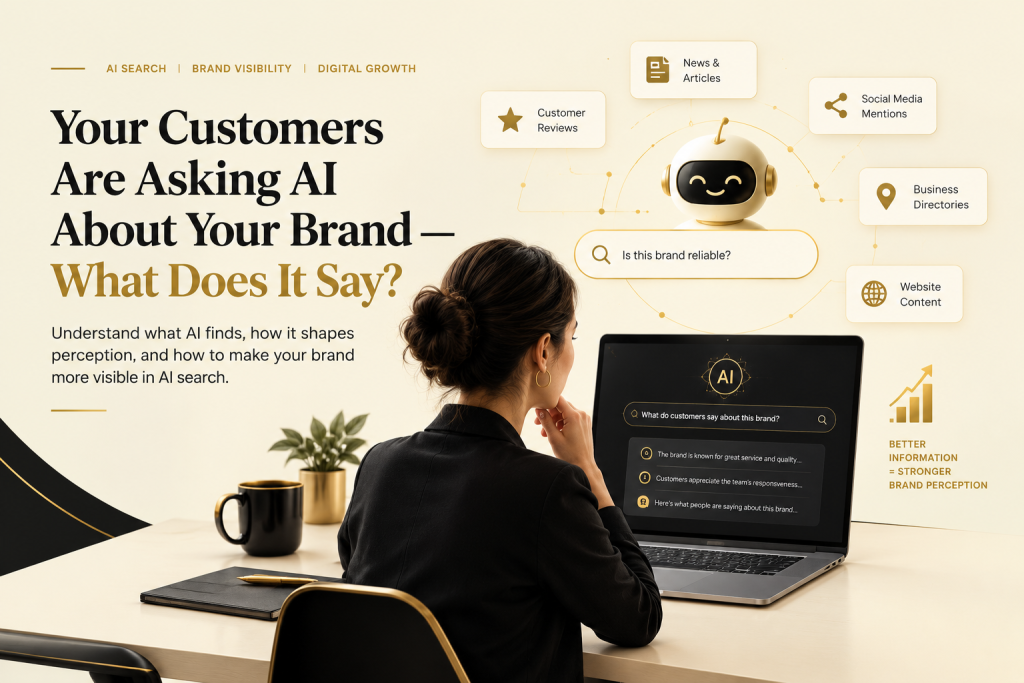
Your Customers Are Asking AI About Your Brand — What Does It Say?

AI SEARCH & BRAND VISIBILITY Your Customers Are Asking AI About Your Brand — What Does It Say? A few years ago, someone researching a business typed something like “best digital marketing agency near me” into a search bar and scrolled through ten blue links. That habit hasn’t disappeared, but it’s no longer the whole story. Increasingly, that same person opens an AI assistant and asks a question instead of a keyword: “Which digital marketing agencies are good for small businesses?” “Is [brand] worth hiring?” “What does [brand] specialize in?” “What are customers saying about [brand]?” “How does [brand] compare with its competitors?” The answer they get back isn’t a list of links they have to click through. It’s a summary — a synthesized impression of who you are, what you do, and whether you’re worth their time. That leads to the question this article is built around: if customers are asking AI about your business, what information is AI finding, and what impression does that information create? This isn’t about chasing a new algorithm or trying to “win” a specific AI platform. It’s about understanding that your brand now has a reputation that lives partly outside your control, shaped by information scattered across the web, and learning how to influence it responsibly. Your Brand Has an AI Reputation Now Every business has always had a reputation that existed outside its own marketing — word of mouth, reviews, press mentions, what a competitor’s salesperson says about you in a pitch meeting. AI search and AI assistants have simply added a new, faster layer to that same phenomenon. When someone asks an AI system about your company, it draws on whatever it can find or recall, then presents that as a coherent answer. That answer is built from a patchwork of signals, not a single dossier. Depending on the system, a customer might be encountering information that originated from: Traditional search engines and the pages they index AI-powered search tools and assistants Review platforms like Google Business Profile, Yelp, or industry-specific review sites Social media profiles and posts Business directories and listing sites News websites and press coverage Industry publications and trade press Forums, communities, and Q&A sites Your own website and published content No single source tells the whole story on its own. What matters is whether these sources, taken together, paint a consistent and accurate picture. When they don’t, the gap gets filled by inference — and inference is where inaccuracies creep in. What Are Customers Actually Asking AI About Your Business? Direct answer: customers are mostly asking the same questions they’ve always asked a knowledgeable friend before buying something — they’re just asking an AI system instead. Understanding those question types helps you decide what your website and online presence need to answer clearly. Discovery Questions “Who offers this service?” — the customer doesn’t know your brand yet; they’re looking for options. Trust Questions “Is this company reliable?” — they’ve found you, and now they’re checking whether you’re legitimate. Comparison Questions “Which company is better for this?” — they’re weighing you against alternatives. Pricing Questions “How much does this service usually cost?” — they want a ballpark before reaching out. Reputation Questions “What do people say about this business?” — they’re looking for social proof. Expertise Questions “Does this company specialize in my industry?” — they want relevance, not just capability. Local Questions “What are the best businesses for this service in [location]?” — geography still matters, even in AI search. Most businesses only prepare answers for the first category — discovery. Trust, comparison, pricing, reputation, expertise, and local relevance are usually left to chance, scattered across whatever third parties happen to have written. Anticipating all seven categories, and answering them clearly across your website and online profiles, is the foundation of AI-ready visibility. Where Does AI Get Information About Your Brand? Different AI-powered search systems and AI assistants use different retrieval, ranking, training, browsing, and indexing methods. Some browse the live web in response to a question. Some rely on information absorbed during training. Some blend both, and lean on structured data or licensed content partnerships. There isn’t one universal system, and no single platform necessarily uses every source listed below — but these are the categories of information that can plausibly feed into an AI-generated answer about a business: Your business website and its published pages Publicly available web pages that reference your company Traditional search engine results Business profiles on platforms like Google Business Profile Customer reviews across review sites News coverage and press mentions Industry websites and trade publications Social media profiles Business directories and listings Structured data (schema markup) on your site Public discussions on forums and community platforms Other sources the specific AI system considers authoritative The practical takeaway isn’t to chase every platform’s exact methodology — that information changes and isn’t always public. It’s to make sure that wherever information about your business does exist, it’s accurate, current, and tells the same story. What Happens When the Information About Your Brand Is Incomplete? Picture a business whose website lists three services, whose Google Business Profile lists five, whose LinkedIn page describes a slightly different focus, and whose most recent press mention is three years old and references a service the company no longer offers. None of this is a scandal. It’s just noise — and noise makes it harder for anyone, human or automated, to form a clear picture. Common gaps that create this kind of noise include: Missing information about services, locations, or specializations Outdated details about pricing, hours, or offerings Conflicting business details across different platforms Weak or vague service descriptions Thin or poorly structured website content Unclear positioning — what you do and who you do it for A lack of authoritative third-party mentions Limited or old customer reviews Outdated directory and profile listings None of these inconsistencies guarantee that an AI system will misrepresent you, exclude you, or rank you differently — that would be an

Scroll to Top