September 12, 2026

AI Search & Modern SEO

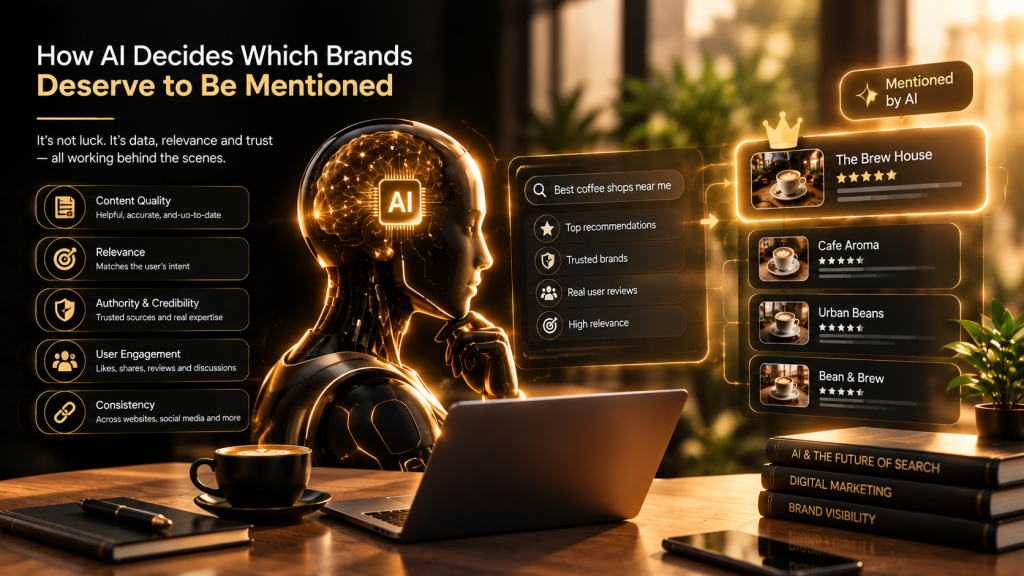
How AI Decides Which Brands Deserve to Be Mentioned

How AI Decides Which Brands Deserve to Be Mentioned A customer opens an AI assistant and types a simple question: “What are the best digital marketing agencies for a small business?” What comes back isn’t a page of ten blue links. It’s a short, confident answer — names, comparisons, sometimes a recommendation. No rankings page. No scrolling. Just an answer. That shift raises an obvious question for anyone running a business today: why does the AI mention some brands and not others? Is there a formula? A trick? A ranking system hiding behind the interface? The honest answer is more nuanced than most marketing content admits. AI-powered discovery isn’t a single ranking for a single keyword. It’s closer to a process of understanding — the system needs to grasp what a brand is, who it serves, and whether it’s genuinely relevant to the question being asked. There is no publicly confirmed universal formula that guarantees a mention, and anyone claiming otherwise is selling something. What this article does instead is walk through the factors that reasonably influence whether a brand gets understood, considered, and mentioned — and just as importantly, what’s genuinely outside a business’s control. If you run a business, manage marketing, or advise clients on visibility, this is the difference between chasing hacks and building something that actually holds up. What Does It Mean When AI Mentions a Brand? Being mentioned by an AI system is not the same as ranking #1 on Google. It’s a different kind of visibility entirely. When an AI system names a brand in response to a question, it’s typically drawing on some combination of: Brand recognition — does enough information exist to identify this business as a distinct entity? Relevance to the question — does the brand actually relate to what the user asked? Contextual association — is the brand connected to the right industry, service, or location? Available online information — is there enough content, in enough places, to describe the brand accurately? Reputation signals — reviews, mentions, and general sentiment attached to the brand Supporting evidence — sources that back up claims about what the brand does and how well it does it Entity understanding — whether the brand is recognized as a clear, singular “thing” rather than a vague or inconsistent presence A mention is not a permanent status. A brand might be highly relevant to one question and completely irrelevant to the next. A local bakery might be a strong answer to “best bakery in town” and have zero relevance to “best CRM software for startups.” That’s not a flaw in the system — it’s exactly how relevance is supposed to work. Does AI Have a “Brand Ranking Formula”? Direct answer: No single universal, public formula exists that guarantees a brand will be mentioned by an AI system. Different AI-powered search and conversational tools run on different models, different retrieval methods, and different combinations of data sources. What influences one system’s output may not influence another’s in the same way, and these systems continue to evolve. This matters because it’s easy to fall for a pitch that sounds like: “Follow these five exact steps and ChatGPT will always mention your brand.” That kind of promise should raise a flag immediately. Nobody outside the companies building these systems has verified access to their internal mechanics, and even employees of those companies would be cautious about describing a fixed, guaranteed process. What’s useful to separate here: Known best practices — things consistently associated with better visibility across search and AI systems (clarity, consistency, authority) Reasonable optimization strategies — structuring content and information in ways that make a brand easier to understand Industry observations — patterns marketers and researchers have noticed, without claiming certainty Speculation about proprietary systems — guesses about internal algorithms that should be treated with real skepticism The rest of this article stays firmly in the first three categories. Relevance Comes First Before authority, before reputation, before anything else — relevance is the foundation. If someone asks an AI system, “Which accounting software is useful for small businesses?” a fashion brand has no reasonable path into that answer, no matter how strong its marketing is. Relevance isn’t about being generally impressive. It’s about being connected to the actual subject at hand. Building that connection means strengthening the association between a brand and: Its industry Its specific services or products The audience it serves The problems it solves The topics it’s genuinely knowledgeable about The locations it operates in, where geography matters This is where focused, well-organized website content does real work. A business that clearly documents what it does, for whom, and where, gives both search engines and AI systems something concrete to work with. Vague, generic pages that could describe almost any company in the industry don’t build that connection — they blur it. Context Matters More Than a Single Keyword Traditional SEO trained a generation of marketers to think in terms of single keywords: rank for “marketing agency,” and the traffic follows. Modern AI-driven search behaves differently. It’s built to understand a user’s actual need, not just match words. Consider the difference between these questions: “best marketing agency” “best marketing agency for a local restaurant” “affordable SEO agency for a startup” “SEO agency that specializes in e-commerce” Each of these carries a different intent, and a brand that’s a strong answer to one might be a poor answer to another. An agency that primarily serves e-commerce clients has a real advantage when the question mentions e-commerce specifically — not because it “ranks higher,” but because its actual specialization matches the actual need being expressed. This is a meaningful shift for businesses to internalize: broad, generic positioning (“we do marketing for everyone”) is harder for both people and AI systems to match to a specific need than clear, specific positioning (“we do SEO and content for e-commerce brands”). How AI Understands What Your Brand Does AI systems don’t have a private meeting with your business to
AI Search & Modern SEO

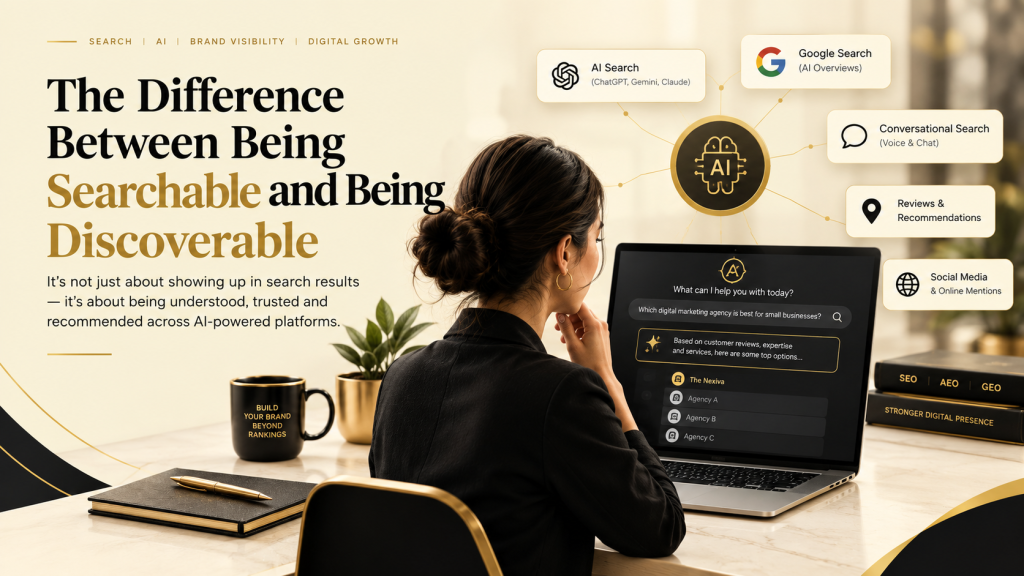
The Difference Between Being Searchable and Being Discoverable

The Difference Between Being Searchable and Being Discoverable Ranking on Google used to be the whole strategy. Today, customers ask questions, use AI assistants, and compare options before they ever click a result. Here’s the real difference between showing up — and being understood, considered and recommended. Talk to THE NEXIVA For years, the only question that mattered in digital marketing was simple: “How do I rank on Google?” Businesses built entire strategies around keywords, backlinks and page one positions. That question hasn’t disappeared, but it’s no longer the whole story. Today, a customer might type a question into Google, ask an AI assistant for a recommendation, search inside a marketplace app, scroll through reviews, or ask a chatbot to compare three companies side by side before ever visiting a website. Somewhere in that mix, a business can rank perfectly well and still never enter the conversation. That’s the gap between two ideas that sound similar but aren’t: being searchable and being discoverable. Being searchable means people can find you if they know roughly what to look for. Being discoverable means the right people encounter your brand, understand why you matter, and consider you — even when they didn’t search for your business by name. One is about visibility in a results page. The other is about being understood well enough, by both humans and the systems humans now rely on, to be recommended. This article breaks down what each term actually means, why the difference matters more than it used to, and what a business can realistically do about it — without chasing shortcuts or unsupported promises about “guaranteed AI visibility.” What Does “Searchable” Actually Mean? Searchable simply means a business can be found through a search query. Your website exists, it’s indexed by search engines, and it shows up when someone types a relevant term into the search bar. Searchability is built on familiar mechanics: Search engine indexing — Google and other engines have crawled and stored your pages Keywords — your content includes the words and phrases people actually type Search rankings — where your pages land on the results page for those terms Organic visibility — how often and how prominently you appear without paid ads Website pages — service pages, landing pages, blog posts that match specific queries Search intent matching — your content lines up with what the searcher is trying to accomplish Here’s a practical example. A plumbing company in Austin might rank in the top five results for “emergency plumber Austin.” That’s real, valuable searchability — it captures people who already know exactly what they need and how to phrase it. But searchability has a ceiling. It only works when someone searches in a way your content is optimized to answer. It says nothing about whether that person trusts you over the next result, whether an AI assistant would mention you in a recommendation, or whether someone asking a broader question — “who’s a reliable plumber for an older home?” — would ever see your name at all. A business can be technically searchable and still be functionally invisible to a large share of its potential customers. What Does “Discoverable” Mean? Discoverability is the broader, deeper quality of being easy to find, understand, and recommend — across more than one channel and more than one type of query. A discoverable brand doesn’t just appear in results. It gets referenced, compared, and suggested because the surrounding digital ecosystem — its website, reviews, mentions, content and reputation — gives a clear, consistent picture of who it is and who it’s right for. A genuinely discoverable business tends to be: Easy to understand within seconds of encountering it Clearly relevant to specific customer needs, not just broad categories Present across multiple useful sources, not only its own website Clearly associated with specific products, services or specialties Consistently represented — same name, story and details everywhere Backed by content that actually answers real questions Supported by genuine reviews, mentions and third-party references Structured in a way that’s easy for modern search systems to interpret In simple terms: searchability gets you onto the field. Discoverability determines whether you’re actually in the game when someone is trying to make a decision. Searchable vs. Discoverable: What Is the Difference? Factor Searchable Discoverable Primary goal Appear in search results Be understood, considered and recommended Search behavior Matches specific keyword queries Matches broader questions, comparisons and needs Keywords Central to visibility One input among many signals Content Optimized for target terms Answers real questions with genuine depth Brand understanding Not required Central requirement AI visibility Not addressed Directly relevant Customer journey Often a single search-and-click Spans multiple touchpoints and sources Online mentions Not necessary Meaningfully contributes Reviews Not a ranking requirement Reinforces trust and relevance Entity signals Minimal role Helps systems understand who you are Context Page-level Brand-level, across the web Recommendations Rare outcome Core outcome Long-term visibility Vulnerable to algorithm shifts More resilient, built on consistent presence Notice the pattern: searchability is largely about a page matching a query. Discoverability is about a brand matching an understanding — one that’s built up from many sources over time. A Business Can Be Searchable But Still Not Discoverable Consider a local digital marketing agency. It ranks respectably for “SEO services [city name].” That’s solid, hard-won searchability. But when someone asks a more natural, conversational question — “which digital marketing agency is best for helping a small business build an online presence?” — that same agency may never come up. Not necessarily because it’s a worse agency, but because the broader ecosystem of information about it doesn’t clearly answer that specific, more open-ended question. There could be several reasons, and it’s worth being honest that no one outside a given platform can say with certainty exactly how any AI system weighs these factors: Its content may focus narrowly on service keywords rather than the underlying customer problem It may have limited mentions or reviews beyond its own website Its positioning — who

Uncategorized

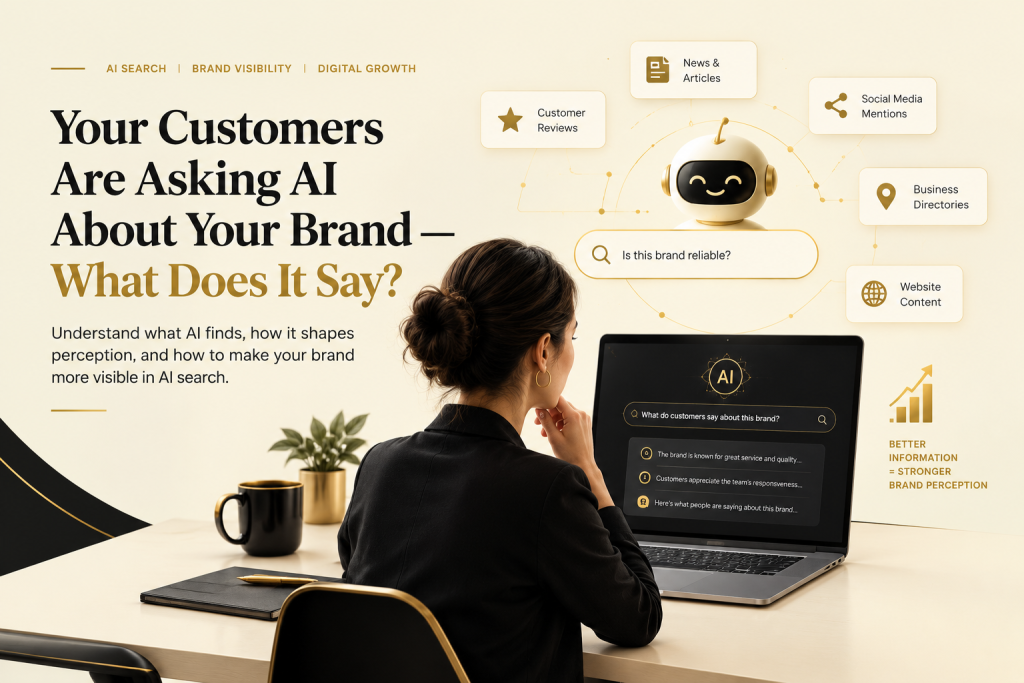
Your Customers Are Asking AI About Your Brand — What Does It Say?

AI SEARCH & BRAND VISIBILITY Your Customers Are Asking AI About Your Brand — What Does It Say? A few years ago, someone researching a business typed something like “best digital marketing agency near me” into a search bar and scrolled through ten blue links. That habit hasn’t disappeared, but it’s no longer the whole story. Increasingly, that same person opens an AI assistant and asks a question instead of a keyword: “Which digital marketing agencies are good for small businesses?” “Is [brand] worth hiring?” “What does [brand] specialize in?” “What are customers saying about [brand]?” “How does [brand] compare with its competitors?” The answer they get back isn’t a list of links they have to click through. It’s a summary — a synthesized impression of who you are, what you do, and whether you’re worth their time. That leads to the question this article is built around: if customers are asking AI about your business, what information is AI finding, and what impression does that information create? This isn’t about chasing a new algorithm or trying to “win” a specific AI platform. It’s about understanding that your brand now has a reputation that lives partly outside your control, shaped by information scattered across the web, and learning how to influence it responsibly. Your Brand Has an AI Reputation Now Every business has always had a reputation that existed outside its own marketing — word of mouth, reviews, press mentions, what a competitor’s salesperson says about you in a pitch meeting. AI search and AI assistants have simply added a new, faster layer to that same phenomenon. When someone asks an AI system about your company, it draws on whatever it can find or recall, then presents that as a coherent answer. That answer is built from a patchwork of signals, not a single dossier. Depending on the system, a customer might be encountering information that originated from: Traditional search engines and the pages they index AI-powered search tools and assistants Review platforms like Google Business Profile, Yelp, or industry-specific review sites Social media profiles and posts Business directories and listing sites News websites and press coverage Industry publications and trade press Forums, communities, and Q&A sites Your own website and published content No single source tells the whole story on its own. What matters is whether these sources, taken together, paint a consistent and accurate picture. When they don’t, the gap gets filled by inference — and inference is where inaccuracies creep in. What Are Customers Actually Asking AI About Your Business? Direct answer: customers are mostly asking the same questions they’ve always asked a knowledgeable friend before buying something — they’re just asking an AI system instead. Understanding those question types helps you decide what your website and online presence need to answer clearly. Discovery Questions “Who offers this service?” — the customer doesn’t know your brand yet; they’re looking for options. Trust Questions “Is this company reliable?” — they’ve found you, and now they’re checking whether you’re legitimate. Comparison Questions “Which company is better for this?” — they’re weighing you against alternatives. Pricing Questions “How much does this service usually cost?” — they want a ballpark before reaching out. Reputation Questions “What do people say about this business?” — they’re looking for social proof. Expertise Questions “Does this company specialize in my industry?” — they want relevance, not just capability. Local Questions “What are the best businesses for this service in [location]?” — geography still matters, even in AI search. Most businesses only prepare answers for the first category — discovery. Trust, comparison, pricing, reputation, expertise, and local relevance are usually left to chance, scattered across whatever third parties happen to have written. Anticipating all seven categories, and answering them clearly across your website and online profiles, is the foundation of AI-ready visibility. Where Does AI Get Information About Your Brand? Different AI-powered search systems and AI assistants use different retrieval, ranking, training, browsing, and indexing methods. Some browse the live web in response to a question. Some rely on information absorbed during training. Some blend both, and lean on structured data or licensed content partnerships. There isn’t one universal system, and no single platform necessarily uses every source listed below — but these are the categories of information that can plausibly feed into an AI-generated answer about a business: Your business website and its published pages Publicly available web pages that reference your company Traditional search engine results Business profiles on platforms like Google Business Profile Customer reviews across review sites News coverage and press mentions Industry websites and trade publications Social media profiles Business directories and listings Structured data (schema markup) on your site Public discussions on forums and community platforms Other sources the specific AI system considers authoritative The practical takeaway isn’t to chase every platform’s exact methodology — that information changes and isn’t always public. It’s to make sure that wherever information about your business does exist, it’s accurate, current, and tells the same story. What Happens When the Information About Your Brand Is Incomplete? Picture a business whose website lists three services, whose Google Business Profile lists five, whose LinkedIn page describes a slightly different focus, and whose most recent press mention is three years old and references a service the company no longer offers. None of this is a scandal. It’s just noise — and noise makes it harder for anyone, human or automated, to form a clear picture. Common gaps that create this kind of noise include: Missing information about services, locations, or specializations Outdated details about pricing, hours, or offerings Conflicting business details across different platforms Weak or vague service descriptions Thin or poorly structured website content Unclear positioning — what you do and who you do it for A lack of authoritative third-party mentions Limited or old customer reviews Outdated directory and profile listings None of these inconsistencies guarantee that an AI system will misrepresent you, exclude you, or rank you differently — that would be an

Scroll to Top